
The Anatomy of Betrayal: When Failure Meets Redemption
*Reflecting on Matthew 26, Matthew 27, Luke 22, and John 21*

There are wounds in life that don't come from enemies. The deepest cuts—the ones that sit heavy in your chest and reshape how you trust—come from people who knew you, prayed with you, stood next to you. People who had access to your story and still chose to hurt you anyway.
If we're honest, we all know what betrayal feels like. But here's the harder truth: sometimes we're not just the ones who were betrayed. Sometimes we're the one who did the betraying.
## **The Kiss: When Betrayal Wears a Familiar Face**
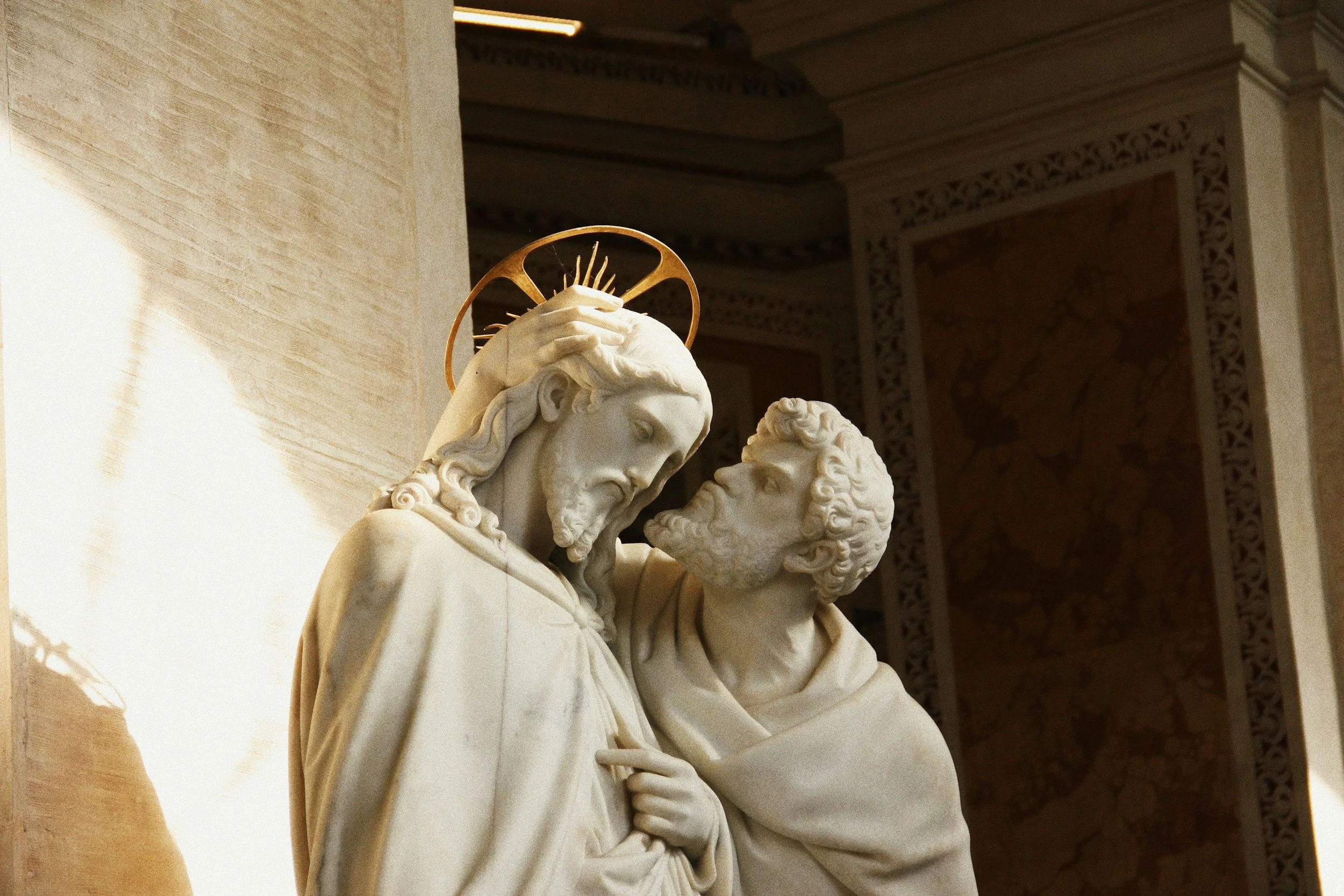
Judas didn't point Jesus out from across the garden. He didn't shout or swing a sword. He walked up calmly, familiarly: *"Greetings, Rabbi,"* and kissed him (Matthew 26:49).
That's what makes betrayal so dangerous—it doesn't look like opposition. It looks like relationship. It doesn't knock like an enemy; it walks in like a friend.
**Betrayal requires access.** You can't betray what you don't have proximity to. You can't wound what you can't reach. Church hurt doesn't come from people outside the church—it comes from those who served beside you, shouted with you, laid hands on you.
But let's turn the mirror around. Every time God called and you took your time—that was your kiss. Every time you lifted hands in worship but lived in contradiction to His will—that was your kiss. We've mastered looking devoted while remaining disconnected.
Judas didn't betray Jesus in a moment. He'd disconnected from the mission long before (John 12:4-6). He complained about the woman's alabaster box, valuing comfort over calling, approval over obedience.
Anytime we value access over accountability, we're already carrying the seeds of betrayal.
## **The Collapse: When Regret Isn't Enough**
Here's where Judas's story gets heavy. He realizes what he's done and feels *authentic remorse*. He returns the money. He confesses: *"I have sinned"* (Matthew 27:4).
But he never returned to Jesus.
**That's the tragedy: regret is not repentance.**
Regret is emotional. Repentance is directional. Regret says, "I feel bad." Repentance says, "I'm coming back."
Judas had the right feeling but the wrong direction. He ran back to the same system that had used him—the chief priests who manipulated his failure then dismissed him: *"What is that to us? That's your responsibility"* (Matthew 27:4).
Sound familiar? You know what it feels like to be used up by systems, relationships, environments. You gave everything, and when you broke, there was no grace. They extracted what they needed and left you with the broken pieces.
**That's the cruelty of broken systems: they extract, but they don't restore.**
But hear this clearly: **Your pain may explain your fall, but it doesn't have to define your future.**
Judas's greatest failure wasn't the betrayal—it was believing he was beyond redemption. He didn't hang himself because he'd messed up. He hanged himself because he thought he couldn't get up.
And the devil is a liar.
There is *nothing* you can do that places you beyond the redemptive power of Jesus Christ. You are not too far.
## **The Comeback: Same Failure, Different Futures**
On the same night, Judas betrays and Peter denies. Peter—the bold one who said, "I'll never leave you"—curses, denies, runs. Three times (Luke 22:54-62). And like Judas, Peter weeps bitterly.
Same failure energy. Different directions.
**Judas ran away from Jesus. Peter stayed in the orbit of Jesus.**
That difference changed everything. Because **failure doesn't determine your future—direction does.**
Same storm, different response. One said, "I'm done." The other said, "Lord, help me."
You don't have to be perfect to be used by God, but you do have to be present.
## **Love Lifted Me: The Breakfast on the Beach**
When Jesus rises, He doesn't go looking for Judas—not because He didn't love him (He called him "friend" even in betrayal), but because Judas had already checked himself out of the story.
But Jesus goes looking for Peter. Finds him back fishing, back in old habits, back where he started.
And Jesus cooks breakfast (John 21:9).
**God will meet you in the place you fell back into.**
Then He asks: *"Do you love me?"* Not once. Not twice. Three times. One for every denial. Every place Peter was broken, Jesus confronts—not to condemn, but to restore.
*"Feed my sheep. Feed my lambs."* (John 21:15-17)
The same mouth that denied Him becomes the mouth that preaches at Pentecost, where 3,000 souls are saved (Acts 2:41).
**Failure can still be fruitful.**
Jesus doesn't ask Peter what he did or why he failed. He asks: *"Do you still love me?"*
Because if love is still there, purpose is still there. If love is still there, your calling is still there.
## **Your Turn: Coming Back**
Somebody reading this is carrying failure like a weight on your chest. You've been replaying your mistake over and over. You've stopped seeing a future for yourself. You believe: *"I went too far. God can't still have a plan for me."*
That's Judas talking.
But there's another voice—the same Jesus you denied, disappointed, or walked away from is still calling your name.
This isn't the end of your story. What the enemy meant for your destruction, God is about to use for your development. What tried to bury you, He's using to build you. What tried to end you, He'll use to elevate you.
**Judas had a failure and made it final. Peter had a failure and made it fruitful.**
The only difference? He came back.
---
**Your failure didn't finish you.** Not next week, not next year—right now, things are turning around. Not because you got everything right, but because you made a decision to come back.
All Jesus wants to know is: *Do you still love me?*
If you do—come back. Step forward. This isn't about your perfection. It's about your direction.
And the moment you step toward Him, everything starts shifting.
*"Love lifted me when nothing else could help. Love lifted me."*
---
**Prayer:**
*God, I'm coming back. Whatever I've been running from, hiding from, carrying—I'm coming back. My failure didn't finish me. Thank you for still calling my name. Amen.*